Building technology · 4 min read
What an EMF-protected home actually means
EMF-protected home: R·Evolution calls EYWA the world's first EMF-protected residential building. What the presentations state and what to ask in writing.
- Published
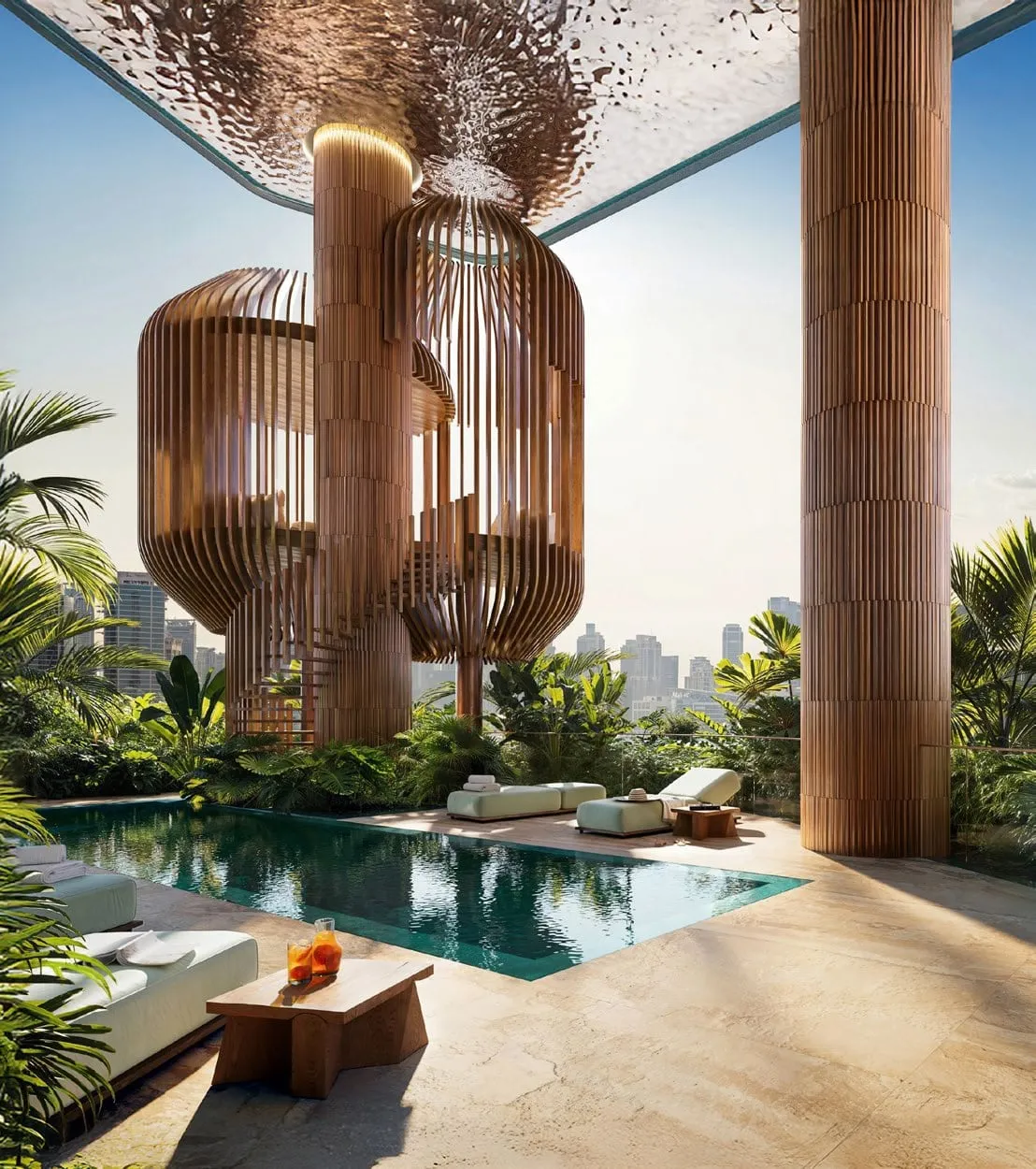
Among the claims in the EYWA sales material, one stands out because it is falsifiable: EMF protection, described in both presentations as belonging to “the world’s first residential building”. Most wellness features in luxury real estate are matters of taste. Shielding is not — it is measurable in decibels of attenuation, and it either exists in the specification or it does not. That makes it worth reading carefully.
What the developer actually states
Two statements, repeated across the Tree of Life and Way of Water decks. First, under the heading of advanced technologies for health: EMF protection, with the parenthetical claim that this is the world’s first residential building to carry it. Second, in the residences section: the homes “include integrated EMF protection and are meticulously processed during construction to prevent mould and fungi”. The wording matters. Protection is described as integrated during construction rather than added afterwards, which points at the building fabric — wiring, envelope, finishes — rather than at plug-in devices.
There is one further, very concrete element. On the amenities floor both towers carry a lounge and a cave fitted with Faraday mesh curtains, described in the deck as a place to relax “free from any electromagnetic waves”. A Faraday mesh is not a wellness metaphor; it is a conductive enclosure that attenuates radio-frequency fields. The presence of a named shielding technique in a shared space is the most checkable part of the claim, and it is one of the more unusual entries on the amenities list.
What shielding involves as engineering
The developer material does not publish a technical specification, so what follows is general engineering practice rather than a description of EYWA. It is the vocabulary you need in order to ask precise questions.
Electromagnetic exposure inside a home comes from two families of source. Radio-frequency fields arrive from outside — mobile base stations, neighbours’ routers, the building’s own wireless infrastructure. Extremely low frequency fields are generated inside, by mains wiring, distribution boards, transformers and appliance motors. The two are mitigated differently.
Radio-frequency attenuation is achieved by making the envelope conductive: shielding paints and membranes, metallised glazing, conductive mesh in plaster or behind board, and continuity at the joints. Continuity is the whole game — a shielded wall with an unsealed penetration performs roughly like an unshielded wall.
Low-frequency mitigation is a wiring discipline instead. Shielded and twisted cabling, careful separation of circuits from bed-head and desk positions, star topologies rather than long loops, and demand switches that de-energise a circuit when nothing draws current on it. None of this is exotic; it is routine in building-biology practice in German-speaking Europe, where it is measured against the SBM guidance used by testing engineers.
Why the health argument is contested — and what that changes
Any honest article has to say this plainly: the health effects of everyday low-level exposure are not settled science. The International Agency for Research on Cancer classified radio-frequency electromagnetic fields as possibly carcinogenic to humans, Group 2B, in 2011, and that classification has not been upgraded. Major public health bodies continue to hold that exposure below international guideline limits has no established adverse effect. Anyone telling you the matter is closed, in either direction, is selling something.
That does not make shielding pointless. It makes it a preference, like acoustic isolation or filtered air, and preferences are exactly what a buyer at this price point is entitled to specify. It sits alongside the other measurable systems described on the wellness technology page: MERV 14 filtration with ionisation, materials tested as non-toxic and radiation-free, and the centralised water treatment.
The four questions to ask in writing
Before reservation, ask the developer for four things, and ask for them in writing. One: the shielding specification by element — envelope, glazing, internal partitions, wiring. Two: the target attenuation figure, in decibels, and the frequency range it applies to. Three: whether commissioning includes measurement by an independent testing engineer, and whether the report will be issued to buyers. Four: what happens to the shielding performance when the resident installs their own wireless network inside the shielded volume, since an internal transmitter is unaffected by an external shield.
Answers to those four turn a marketing claim into a specification. If you want us to put them to the developer for a specific unit, ask through the contact form and we will come back in writing.
Developer claims are attributed as such. Figures come from the R·Evolution sales presentations for Tree of Life and Way of Water unless another source is named.
Sources used
Source: EYWA Tree of Life — developer presentation (73 pp.) ; EYWA Way of Water — developer presentation (109 pp.)
Data updated: 2026-08-29
Related articles
Design principles · 4 min read
Who designed EYWA Dubai? Architects behind Tree of Life and Way of Water
EYWA Dubai architects: OAD leads architecture and interiors for Way of Water, with John R Harris & Partners as lead design consultant.
Published:
Read the articleProject update · 3 min read
EYWA Dubai update: construction, five available residences and current terms — August 2026
EYWA Dubai construction update, August 2026: Tree of Life and Way of Water status, five named available residences, exact list prices and handover context.
Published:
Read the article
Market thesis · 4 min read
Wellness real estate: the developer's case for why buyers pay for health
Wellness real estate: R·Evolution's case that a building is an instrument of longevity, how EYWA is priced on it, and what LEED, WELL and WiredScore audit.
Published:
Read the article